Cyber security
8 Ways to Prevent Cyber Attacks and Data Breaches

It’s 2021, and considering the ever-increasing threats to businesses due to data breaches, the need for cybersecurity is more urgent than ever.
One simple hack can make the sensitive data of your enterprise vulnerable, and you might have to pay heavy fines to retrieve it. In some cases, your business can witness a downfall due to financial loss.
But how to prevent a cyber-attack and achieve robust security for your business?
The most secure and reliable way to fight such data breaches is prevention. In this blog, we will list down the ways you can protect your business from cyber-attacks and data breaches.
Let’s understand about a Cyber Attack
When a malicious code is used to compromise your data or computer, leak sensitive information about any business, then it can be called a Cyber Attack. It can be defined as a deliberate attempt by cybercriminals to exploit systems or networks and later demand hefty amounts of money from the business owners.
Below are the most common cyberattacks and data breaches:
- Website defacement
- Intellectual property (IP) theft
- Identity theft
- Instant messaging abuse
- Password sniffing
- Stolen hardware: laptops or mobile devices
- Private and public Web browser exploits
- System infiltration
- Breach of access
- Denial-of-service
- Malware
- Phishing
- Spamming
- Trojans, spyware, or viruses
See Our Tips on the Infographic Below
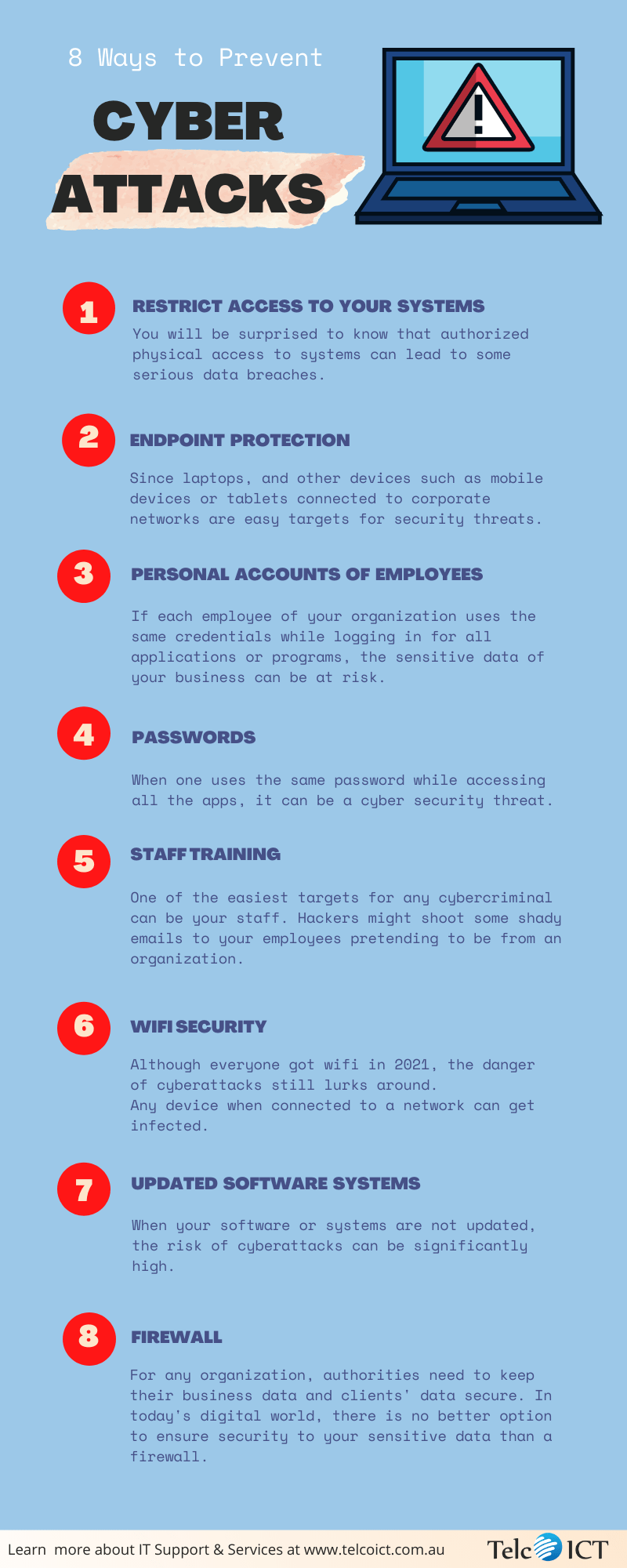
1. Restrict access to your systems
You will be surprised to know that authorised physical access to systems can lead to some serious data breaches. Let’s say anyone can walk right into your office, plug in an infected USB key into your computer and thus get unrestricted access to the whole network.
In organisations, it is wise to gain insights on how to prevent a cyber-attack and thus, install a perimeter security system.
2. Endpoint Protection
Since laptops and other devices, such as mobile devices or tablets connected to corporate networks, are easy targets for security threats, these paths need to be protected with specific endpoint protection software. Otherwise, you can get help from an IT service provider to secure your data.
3. Personal Accounts of Employees
If each employee of your organisation uses the same credentials while logging in for all applications or programs, the sensitive data of your business can be at risk.
Instead, try assigning different logins for each employee to eliminate the possibility of any cyber attack.
Apart from robust security, you can expect improved usability as the right access is given to the right employee. You can reach out to Telco ICT for business IT support in Melbourne for more assistance.
4. Passwords
When one uses the same password while accessing all the apps, it can be a cybersecurity threat. If a hacker cracks the password, unlimited access is given to all apps or systems.
Thus, it is safe to set up different passwords for each app and ensure robust security. It will go a long way in protecting your data from internal or external threats. You can even reach out to a genuine or reputable IT service provider for more such best practices.
5. Staff training
One of the easiest targets for any cybercriminal can be your staff. Hackers might send some shady emails to your employees pretending to be from an organisation.
In some cases, employees might even be asked to share personal details or access to some crucial files. Mostly, links can mislead naive employees with no awareness.
Thus, it is vital for each employee to be aware of how to prevent cyber attacks. You can also seek assistance from a business IT support Melbourne, such as Telco ICT, for more insights.
Some of the best practices your employees can follow:
- Check each email address received.
- Never share any sensitive data with strangers.
- Cross-check links before clicking on them.
- Call your senior management or IT person if some mail or a call looks shady.
6. Wifi Security
Although everyone got wifi in 2021, the danger of cyberattacks still lurks around.
Any device, when connected to a network, can get infected. In return, if this device gets connected to a business network, the whole enterprise’s data will be in grave danger.
Since several devices get connected to your network, it is crucial to secure your wifi network and thus protect against data breaches. For more insights to secure your wifi network, reach out to a reputable business IT support Melbourne.
7. Updated software systems
When your software or systems are not updated, the risk of cyberattacks can be significantly high.
Cybercriminals leave no stone unturned to exploit such loopholes and use such opportunities for their advantage to gain access to your network.
After they get into the network, it is almost impossible to prevent a data breach. As a preventive measure, you can make a smarter choice by investing in a patch management system to manage software or system updates. Thus, your system can stay updated and stay resilient.
8. Firewall
For any organisation, authorities need to keep their business data and clients’ data secure. In today’s digital world, there is no better option to ensure the security of your sensitive data than a firewall.
Be it keeping viruses away or stopping unauthorised access of cyber criminals, firewalls can prove to be the frontline defence for your organisation in fighting data breaches.
Let’s also focus on legal policies related to data security. GDPR (General Data Protection Regulation) is the European Union’s new data protection law that came into effect on 23th May, 2018.
GDPR emphasises that businesses need to collect the required data for legitimate purposes only.
I am running a business in Australia. Will the GDPR apply to me?
GDPR got its obligation, and since it is global scale, they got the power to take action only under specific circumstances. If you are running a business in Australia, there is a possibility that GDPR also applies to you and your clients, too.
My Australian business involves processing the personal data of EU citizens. Do I need to worry?
If you are processing any personal data specifically related to EU citizens, then yes, GDPR can apply to your business. For more information, seek help from an external legal counsel.
Preventive steps to avoid your business from violating the GDPR
- Update your privacy policy
- Review the data collected
- Delete any extra personal data
- Audit the personal information gathered
- Ensure the third-party providers comply with GDPR
- Make sure the personal data collected is safeguarded
Although you are aware of the need to have robust security to protect business data, sometimes, the information can be too overwhelming for your team.
Thus, you need assistance from an IT service provider to adopt best practices of cybersecurity for your organisation. Get in touch with the team of Telco ICT and take a step towards securing your business data and adding more immunity against cyber attacks.
Among the best practices, prevention still stands out as the most effective approach to boost your cybersecurity. Hope this information was helpful to your organisation.
Frequently Asked Questions
- Why is Multi-Factor Authentication (MFA) still necessary if I have a strong password?
Even the strongest passwords can be stolen through data breaches at other companies or highly sophisticated AI-enhanced phishing campaigns. MFA acts as a critical second barrier; even if an attacker has your password, they cannot gain access without your secondary verification, such as a biometric scan or a hardware security key.
- How often should I actually update my software and systems?
In 2026, the “race against the clock” is faster than ever. You should enable automatic updates whenever possible. Cybercriminals now use automated bots to weaponise newly discovered vulnerabilities within hours of their public disclosure, making immediate patching a tactical priority to stay ahead of autonomous malware.
- Can my small business really be a target for a major cyber attack?
Yes. Attackers often view small businesses as “easy entry points” because they typically have less robust security infrastructure but still maintain valuable customer data. Additionally, small firms are frequently targeted as a backdoor into the larger supply chains of their corporate partners.
- Is data stored in the cloud automatically safe from breaches?
No. Most cloud providers operate under a “Shared Responsibility Model”. While the provider secures the physical infrastructure, you are responsible for securing your data, managing user access permissions, and correctly configuring your security settings.
- What is the very first thing I should do if I suspect a data breach?
Immediately activate your incident response plan. This involves isolating affected systems to stop the spread, documenting the incident for legal and insurance purposes, and notifying your security lead. Speed is critical; organisations that respond within hours rather than days significantly reduce their average damage costs.
Also read – Cybersecurity Breaches in Australia in 2021
Table of contents
Related Posts

We’ll handle the tech
so you can get on with
running your business.