Phone System
What Is a PBX Phone System? Which One Is Right for Your Business?

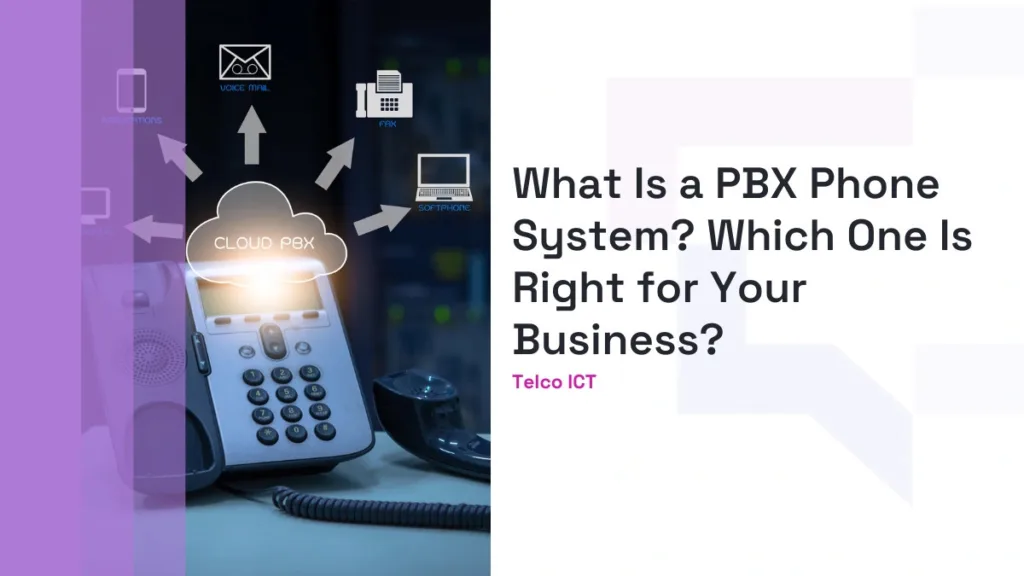
Are you still searching for the best business phone system out there?
We get you. It can be too overwhelming for a buyer due to the loads of information or options available. Since we, at Telco ICT, excel in helping out clients to find the right phone system to fit their business needs, you can rely on our expertise.
We have listed down the different types of PBX phone systems to help you understand which one will be the perfect fit for your business.
First, let’s understand the PBX phone system.
What exactly is PBX?
Private Branch Exchange (PBX) can be perceived as the internal telephone network for your business. Users can communicate with each other through internal lines/phones and even make/receive external calls, thanks to the PBX phone system.
Your business can get voicemail, auto-attendant, call queue, call transfer and call forwarding features through PBX phone system. By leveraging Voice over Internet Protocol (VoIP phones) or digital phone lines, PBX systems are operated. And, the physical phone lines entering your business can also be split into multiple lines.
Best part: Calls among users are free!
Types of PBX phone systems
If you have shortlisted the PBX phone system for your business, then there is still some decision-making work that needs to be done. Below are the types of PBX phone systems we have listed for you:
Analog PBX Phone System
It gained a reputation for being a typical telephone system as it has been used by businesses for decades. Connected through Plain Old Telephone Service (POTS) lines to the Public Switched Telephone Network (PSTN), it can even handle fax transmissions using physical phone lines.
Calls can be made or transferred within a certain location through the analog PBX phone system. Besides, they can even handle outgoing/incoming calls by using outside lines.
Please note that they were around when traditional copper lines were in vogue, and the time when the Internet had never been heard of. Thus, you cannot expect the latest features such as remote working ability, converting voicemail to email or any multimedia services.
Let’s say shortly, your business grows, then you might have to add new telephone wires or new jacks to accommodate new employees, which can be a problem.
Although a little old-school, they work fine even when there is no Internet connection. Amazing!
VoIP PBX Systems
IP PBX or VoIP phones work just like traditional PBX and can be best described as a new version of private branch exchange.
How does IP PBX differ from traditional PBX systems?
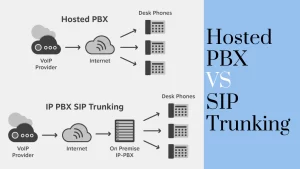
- Offers extra features
- More cost-effective option
- Instead of traditional phone lines, it uses the Internet protocol
- Voice gets converted into data, later to be transmitted through the Internet. Vice-versa.
- Maintenance is super simple
Features:
- Video conferencing
- BOYD (Bring Your Own Device)
- Messaging
On-Premises PBX system
It is a little different from PBX telephone systems, but still leverages VoIP phone technology to manage telephone systems. Please note that servers managing incoming/outgoing calls are maintained on-site. But the features are still the same, offering support for mobile devices, voicemail to email conversion and using Internet connectivity.
Challenges of On-premise PBX:
- The initial upfront cost of installation
- Need to have IT staff with good expertise
- Proper maintenance of phone systems
Good part:
- After expenses are covered, you will be free from fee raises as cost goes down with time
- Let you retain a relationship with the current phone service provider
- Flexibility to configure your system internally
Cloud PBX Systems
Cloud PBX, a subtype of an IP phone system, is also described as a hosted PBX. It runs by leveraging an Internet connection to VoIP phone service providers. Except for physical phones & an Internet connection, no on-site equipment is needed, since everything is handled by the service provider.
All incoming/outgoing calls are routed through the service provider to transmit the voice to data packets and even handle calls off to the Public Switched Telephone Network (PSTN).
All you need to do while using hosted PBX phone systems is have a strong broadband connection to the Internet that supports many telephony devices such as smartphones and office conference phones.
Benefits of Opting for Hosted PBX Phone Systems
- Integration with CRM, Microsoft Teams, & other 3rd-party systems.
- Plug-and-play set-up
- Ideal for small businesses with no funds to invest in telephone infrastructure
- Features to empower customer support teams
- Collaboration features that include conferencing, instant messaging, and screen sharing
- Supporting on-site & mobile workers
- Easy installation and maintenance of unified communications systems
- Scalability
- No hardware equipment & professional IT staff needed.
Benefits of On-site PBX
- Lesser operational costs
- Extra control by owning the equipment
- Building a relationship with the telephone company
- Zero annual or monthly licences/subscription fees
- Much ability to determine the security level
Which one is right for your business?
Now that you have got enough idea about the PBX system, it’s time to decide which type works fine for your business. You need to assess your needs and accordingly pick out the right option.
Below are a few things to consider:
1. Operational model
Do you have your workforce mostly at the office, or do they have to be in the field to connect with the outside world? How exactly does your organisation work? Is your staff more tech-savvy or more old-school?
2. Budget
Whenever services are implemented, they come with certain costs. Some services can be virtually free depending on the choice you make. For instance, On-premises VoIP phones or hosted PBX let you add/remove lines without any hassles at zero cost. But, if you go for an analog configuration, it will lead to physical installation costs or paying up for new lines.
3. Business size and projected growth
Do you have a small/medium-sized enterprise or a larger enterprise? Is it expanding or shrinking in business? Will the number of lines get impacted when you adapt to any type of technology? Will you need features such as remote work support, video conferencing or call routing?
4. Infrastructure
Before going for the best PBX phone system, you need to ask the following questions regarding existing infrastructure:
- Are you working from a single or multiple offices?
- What is the type of legacy system you have to integrate with the new telephony solution?
- Which solution is your business using for telecom these days?
- Got any in-house IT staff?
- If yes, are they experts in telephony concepts like SIP trunking?
Well, if you still have any questions or queries while exploring the right phone system to fit your business needs, Telco ICT can help you out. Meanwhile, you can also explore our wide range of VoIP phone systems available to make an informed decision.
Frequently Asked Questions
- Can I keep my existing phone numbers if I switch to a new PBX system?
Yes, you can transition existing numbers through a process called porting.
- What happens to a Cloud PBX system if the internet goes down?
Calls drop, but you can auto-route them to mobile apps or backup cell numbers.
- What is the difference between a standard VoIP phone and a PBX system?
VoIP is the transmission technology, while PBX is the routing system that manages the calls.
- Do I need to buy special physical phones for a Cloud PBX system?
No, you can use existing computers and smartphones via software apps called softphones.
- How much internet bandwidth does a Cloud PBX system actually require?
Each active voice call typically needs about 100 Kbps of upload and download speed.
Table of contents
Related Posts

We’ll handle the tech
so you can get on with
running your business.