
Most growing Melbourne businesses eventually hit the same wall. The owner or operations manager is making all the technology decisions, the IT support company is fixing problems as they come up, and no one is actually planning where the technology needs to go. That gap, between keeping things running and setting a strategic direction, is exactly where a virtual CIO steps in.
This article explains what a virtual CIO is, what a vCIO service actually delivers, how the cost of a full-time CIO compares, and how to tell whether your business is ready to engage one.
What Is a Virtual CIO (vCIO)?
A virtual CIO, often shortened to vCIO, is an outsourced technology executive who provides strategic IT leadership to your organisation on a part-time or fractional basis. A vCIO is an external professional, meaning they are not on your permanent payroll, but they work closely with your leadership team to set IT strategy, manage risk, plan budgets, and align technology investments with your business goals.
Unlike a traditional break-fix IT support technician, a vCIO focuses on the bigger picture. They are not there to fix your printer or reset a password. They are responsible for managing your technology roadmap, overseeing vendor relationships, and making sure every dollar you spend on technology is working toward your business objectives.
The term virtual chief information refers to the outsourced nature of the role. You get the same quality of thinking and strategic oversight as a full-time CIO, but you only pay for the time and services you actually need. For small to medium-sized businesses that cannot justify a full-time executive hire, this model makes a lot of sense.
What Does a vCIO Service Include?
The scope of a vCIO engagement varies depending on the provider and your organisation’s size and complexity, but most vCIO services include the following:
| Service Area | What It Covers |
|---|---|
| IT Roadmap Planning | Building a multi-year technology roadmap aligned to your business goals, covering infrastructure upgrades, software transitions, and cloud strategy. |
| Cybersecurity Oversight | Reviewing your security posture, identifying cyber risk, developing a security policy, and ensuring cyber compliance obligations are met. |
| Vendor Management | Managing vendor relationships, negotiating contracts, and making sure your managed service agreements are delivering real value. |
| Budget and ROI Planning | Building IT budgets, justifying technology spend, and tracking return on investment on major projects. |
| IT Audit and Review | Running a structured audit of your current environment to identify areas for improvement and reduce duplication or wasteful spend. |
| Risk Management | Identifying, documenting, and mitigating technology risks including cyber threats, data loss, and compliance gaps. |
| Board Reporting | Translating IT performance and risk into plain language for board-level reporting and decision making. |
| Document Management Strategy | Reviewing how your organisation stores, accesses, and governs documents, and recommending improvements to systems and processes. |
A good vCIO provides strategic oversight across all of these areas, but they also act as a translator, taking complex technical concepts and turning them into clear information your leadership team can act on.
The Cost of a Full-Time CIO vs a vCIO
This is where the numbers get interesting. Hiring a full-time CIO in Australia typically costs between $200,000 and $350,000 per year in total remuneration, once you factor in salary, superannuation, bonuses, and benefits. For a medium-sized business or a mid-sized team without the revenue to justify that outlay, it is simply not a realistic option.
A vCIO engagement, by contrast, is typically structured as a monthly retainer or a per-project fee. Depending on the scope and provider, a vCIO service can range from a few thousand to around $10,000 per month, which is a fraction of the cost of keeping a full-time executive on the books.
The other cost that is easy to overlook is the cost of not having strategic IT leadership at all. Reactive IT support keeps the lights on, but it does not build anything. Without someone thinking about the technology roadmap, businesses often end up with a patchwork of systems that do not talk to each other, security gaps that grow quietly, and compliance obligations that only become visible when something goes wrong.
Is a vCIO the Same as an MSP?
No, and this distinction matters. A managed service provider (MSP) is responsible for the day-to-day management and support of your IT environment, covering things like helpdesk, monitoring, patching, and backups. MSPs are operational by nature.
A vCIO works at the strategic level. They do not replace your MSP. They sit above the operational layer and provide strategic IT leadership that guides what your managed service provider should be doing and why.
Many MSPs now offer vCIO services as part of their managed service packages. When this is done well, it creates a clean split between the people keeping your systems running and the strategic thinking that shapes where those systems are headed. Some vCIOs work independently across multiple clients, while others are embedded within an MSP team. Either way, the role is distinct from day-to-day IT support.
Why Reactive IT Support Is Not Enough Anymore
Reactive IT has its place. When something breaks, you need someone to fix it quickly. But reactive support alone leaves businesses exposed in a number of ways that are becoming harder to ignore.
Cybersecurity is the most obvious area. Cyber threats facing Australian businesses have grown significantly over the past few years. Ransomware attacks are now a genuine risk for small to medium organisations, not just enterprise companies. A reactive approach to cybersecurity means you are addressing threats after they land, rather than reducing the likelihood of them landing at all.
The same applies to compliance. Australian businesses across most industries are subject to growing regulatory obligations around data privacy, cyber risk, and IT governance. Governance is no longer just something large corporations worry about. A vCIO keeps an eye on compliance requirements and makes sure your organisation is meeting them proactively, not scrambling to catch up.
A proactive approach, which is what a vCIO gives you, builds resilience into the business instead of just reacting to whatever comes up next.
Cyber Security, Compliance, and the vCIO Role
A vCIO takes ownership of your organisation’s approach to cybersecurity and compliance at a strategic level. This means more than just making sure your antivirus is up to date.
In practice, a vCIO will:
- Conduct or oversee a cybersecurity audit of your environment to identify where you are exposed
- Develop or review your security policy and make sure it reflects current threats and best-practice standards
- Assess your cyber risk profile and help you prioritise the areas that need attention first
- Ensure your organisation meets relevant compliance requirements, whether that is under the Privacy Act, industry-specific regulation, or frameworks like the Essential Eight
- Feed cybersecurity considerations into your technology roadmap so they are built into plans, not bolted on later
- Translate cyber risk into language your board and leadership can understand for reporting and decision making
For Australian businesses handling sensitive customer data, operating in regulated industries, or simply wanting to reduce risk, having a vCIO overseeing cybersecurity at a strategic level provides a level of assurance that helpdesk-level IT support simply cannot offer.
Does Your Melbourne Business Need a vCIO?
Not every business is at the stage where a vCIO is the right next move. Here are the signals that suggest you are getting close to needing one, or that you are already past the point where you needed one and did not realise it.
Signs you are ready for a vCIO:
- Technology decisions are being made reactively, without a plan
- You have no clear IT budget or are unsure whether your current IT spend is delivering value
- Your IT support is operational, but no one is setting a strategic direction
- Cybersecurity and compliance obligations are being managed informally or not at all
- You have grown to a point where your systems are holding the business back
- You are planning a significant change: a new office, a merger, a move to the cloud, or a push into new markets
- Your board or leadership team is asking IT-related questions that your current support team cannot answer
Virtual CIOs are most commonly engaged by small to medium businesses with between 20 and 200 staff, though the model works across a broad range. The key factor is not size alone; it is whether the business has technology complexity that needs strategic oversight and business goals that require technology to support them.
For Melbourne organisations in professional services, construction, healthcare, finance, or any other sector where technology is core to operations, engaging a vCIO sooner rather than later tends to pay off.
How to Choose the Right vCIO or CIO Services Provider
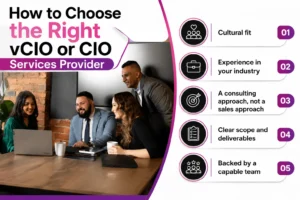 If you decide a vCIO is what your organisation needs, choosing the right partner matters. Here is what to look for:
- Experience in your industry: A vCIO who has worked with businesses like yours will understand the compliance requirements, the common technology challenges, and the vendor landscape you are dealing with.
- A consulting approach, not a sales approach: Be cautious of any provider whose vCIO recommendations always seem to lead back to their own products. A good vCIO is vendor-neutral and gives you recommendations that serve your business needs, not their own margins.
- Clear scope and deliverables: Before engaging a vCIO, make sure you have a clear understanding of what is included, how often you will meet, what reporting you will receive, and how strategic oversight will be maintained between sessions.
- Cultural fit: A vCIO is going to be in your leadership conversations. They need to be someone your team can work with and trust.
- Backed by a capable team: The best virtual CIO services are supported by a skilled technical team. The vCIO sets the strategy; an experienced managed IT services delivery team executes it.
Whether you are based in Melbourne, Western Australia, or anywhere else across Australia, the fundamentals of a good vCIO engagement are the same: clear goals, honest communication, and a focus on solutions that align with where your business is headed.
What ROI Can You Expect From a vCIO?
This is the question most business owners ask, and it is a fair one. The return on investment from a vCIO engagement shows up in several ways:
- Avoided costs: Better vendor management, smarter procurement, and reduced wasteful spend on tools and licences that are not delivering value.
- Reduced risk: Fewer cyber incidents, better compliance posture, and less exposure to the financial and reputational damage that comes from getting these things wrong.
- Faster decision-making: When technology decisions are informed by strategy, they happen faster and with more confidence. Projects stall less often.
- Business outcomes: Technology that is properly aligned with business objectives drives real results, whether that is faster client onboarding, lower operational overhead, or better scalability as the business grows.
The ROI is rarely confined to a single line item. It shows up across the business over time, and the compounding effect of having strategic IT leadership in place, as opposed to working without it, tends to grow the longer the engagement runs.
Strategic IT Leadership Without the Full-Time Cost
The phrase that comes up time and again with vCIO services is leadership without the cost. It captures something real. Mid-sized businesses need strategic IT leadership just as much as large enterprises do, but the budget to hire a full-time executive is often not there, and the business is not yet large enough to justify it.
A vCIO gives you executive-level thinking and strategic oversight without the cost or commitment of a full-time salary. It is a model that has become increasingly popular across Australia over the past five years, as businesses recognise that technology strategy is too important to leave on the back burner.
For businesses looking to scale, manage risk, and make technology work harder for them, virtual CIO services offer a practical, cost-effective way to get there.
Ready to talk about virtual CIO services for your Melbourne business?
Telco ICT Group works with small to medium businesses across Melbourne and beyond, providing managed IT services that include vCIO support and strategic IT leadership. If you are tired of reactive IT and ready to build a technology strategy that actually supports where your business is headed, get in touch with our team.
Frequently Asked Questions
What is the difference between a vCIO and a CIO in Australia?
A CIO in Australia is a full-time executive hired into your organisation, typically at a senior leadership level. A vCIO delivers the same strategic IT leadership on a part-time or fractional basis, working across multiple clients rather than being dedicated to one organisation. The strategic output is comparable; the cost and commitment structure is very different.
How many hours a month does a vCIO typically work?
This varies depending on your organisation’s size and complexity, and on the scope agreed at the start of the engagement. Some businesses engage a vCIO for a day or two per month for high-level oversight and quarterly planning. Others require more regular involvement, particularly if there are active projects, a digital transformation initiative underway, or complex compliance requirements being managed.
Can a vCIO work alongside our existing IT team or MSP?
Yes, and this is one of the more common arrangements. A vCIO sits above the operational layer, providing strategic direction while your existing IT team or managed service provider handles day-to-day support. This kind of co-managed model is particularly effective for businesses that have competent technical support but lack the strategic oversight layer.
What size business is a vCIO best suited for?
Virtual CIOs work best with medium-sized businesses and mid-sized businesses, generally in the 20 to 200 staff range, though the model scales up and down depending on complexity. The defining factor is whether the business has genuine technology strategy needs that are not being addressed by operational IT support alone.
How do we get started with a vCIO engagement?
Most engagements start with an IT audit of your current environment. This gives the vCIO a clear picture of where things stand, what the gaps are, and where the biggest areas for improvement exist. From there, the vCIO works with your leadership team to build out an initial roadmap and establish the ongoing rhythm of strategic oversight that keeps things on track.
Table of contents
Related Posts

We’ll handle the tech
so you can get on with
running your business.